
Introduction
When visiting Malta’s places of interest—whether churches, palaces, or fortifications—one often comes across commemorative marble plaques and inscriptions in Latin, Greek, or Italian. These texts were frequently installed as mementos by the founders of the building themselves, though others were added years later.
Some inscriptions provide details about who financed the project or identify the architect or military engineer involved. In certain instances, they recount the history of a previous structure and explain why it was dismantled or restored. Others, particularly those on fortifications, feature short epigrams highlighting the purpose of the edifice. Prime examples include the inscriptions on the sentinel box at the Gardjola at Senglea Point, the inner gate of Couvre Porte in Birgu, and the twin gates of Porte des Bombes. Beyond these, numerous Latin and Italian inscriptions can also be found beneath religious niches throughout the islands.
However, for amateur historians and roaming “culture vultures” like myself, trying to decipher these Latin and Greek texts has always been a daunting task. That is why I recently decided to embark on a personal project to unlock the meanings hidden within these marble tablets.
The idea for this project came recently after I perused the handouts provided by the late Rev. Canon Ġwann Azzopardi during a lecture at the Institute of Tourism Studies. As I am no Latinist, I must candidly admit that I included his notes in this article as they were—after all, why leave such valuable information on a shelf gathering dust? Beyond these notes, I gathered additional material from various literary sources where Latin inscriptions were recorded alongside English or Maltese translations. Occasionally, I consulted AI tools to fill in the gaps.
The following texts are organized by locality, beginning with Valletta and Floriana, moving through the Grand Harbour towns, and continuing to other sites across the islands.
—–
VALLETTA
Location of inscription:
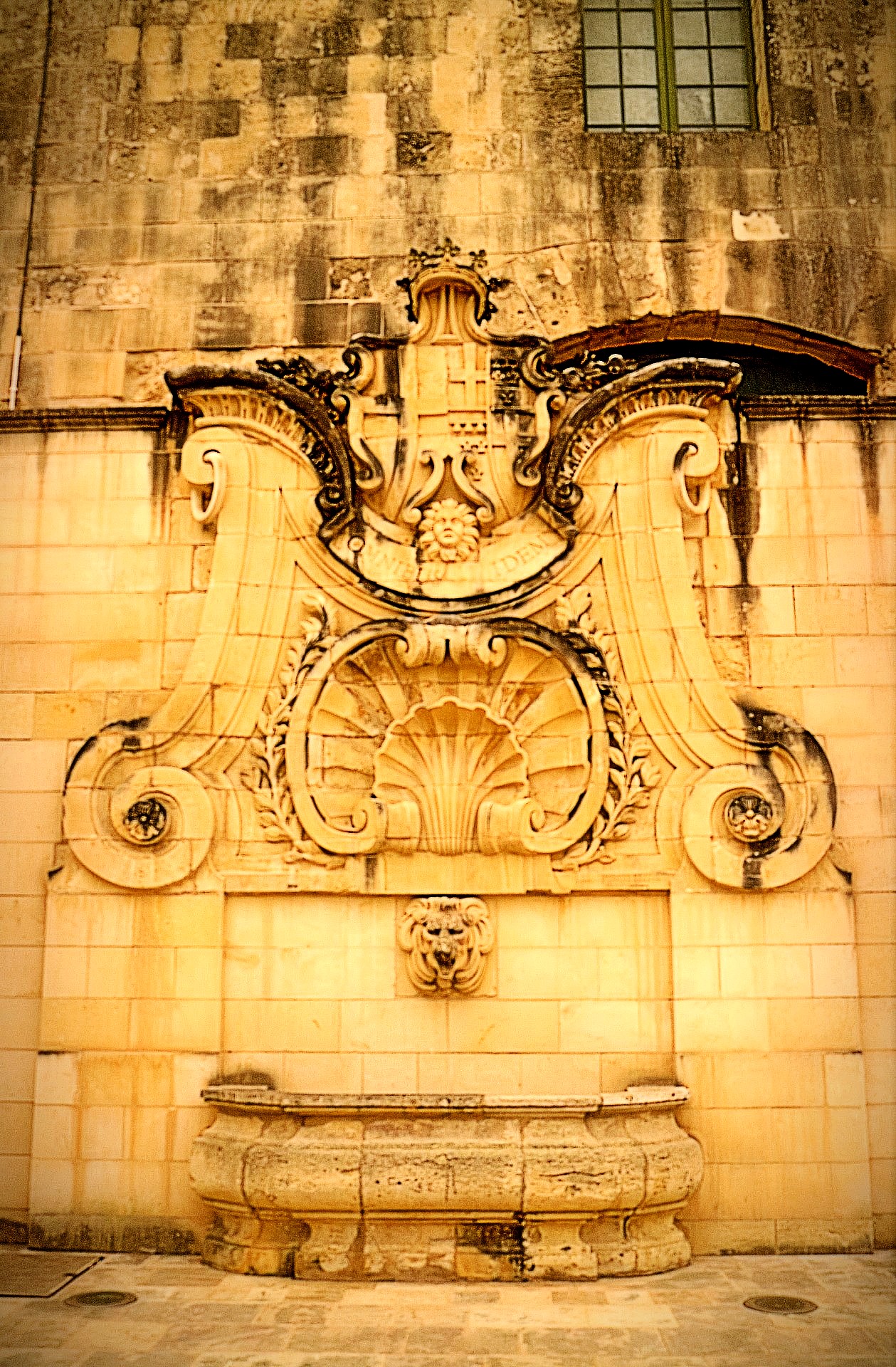
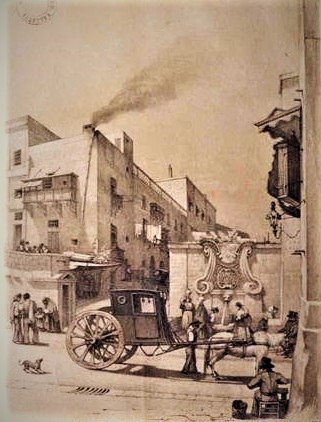
Wignacourt Fountain
(presently abutting St Jame’s Cavalier)
Text of Latin inscription:
OMNIBUS IDEM
Translation:
To all the same
Comment: This concise statement makes it clear—at least to those familiar with Latin—that the fountain’s water was intended for everyone without distinction. It is worth noting that the fountain was originally located near Porta Reale, in Strada San Giorgio (now Republic Street). It was one of several installed in Valletta as part of the Wignacourt aqueduct project, constructed between 1610 and 1615 and officially inaugurated on April 21, 1615.
——
Location:
The facade of the
CASTELLANIA
Merchants Street
Latin Inscription:
DEO. OPT. MAX.
EMANUEL PINTO M.M. ET PRINCEPS
HUNC UTRIUSQUE JUSTITIAE LOCUM
VETUSTATE PROPE LABENTEM,
AD TERROREM POTIUS QUAM AD POENAM
A FUNDAMENTIS AERE PROPRIO
ANNI FERE SPATIO
RENOVAVIT
AUDCIT(?)XIT, ANNO DOM.
MDCCLVIII
Translation:
To God, Supreme, Almighty
Emmanuel Pinto Grand Master and Prince
Restored from its foundations and enlarged
From his own purse
Within about one year
This old almost collapsing
Place for both justices
More than punishment than for fear
In 1758
Comment: Originally built in 1572, the Castellania is one of the earliest buildings in Valletta. Under the rule of the Order of St. John, it served as the Court of Justice, handling both civil and criminal legal matters. In 1758, the original structure was demolished and rebuilt with its striking Baroque facade. It continued to function as the law courts for many years after the British took control of Malta. The Castellania also housed prison cells for individuals awaiting trial as well as convicts sentenced to death. In the mid-19th century, the courts were gradually relocated to the former site of the Auberge d’Auvergne.
—–
Location: Above the portico of the
MAIN GUARD Building
Pjazza San Ġorġ
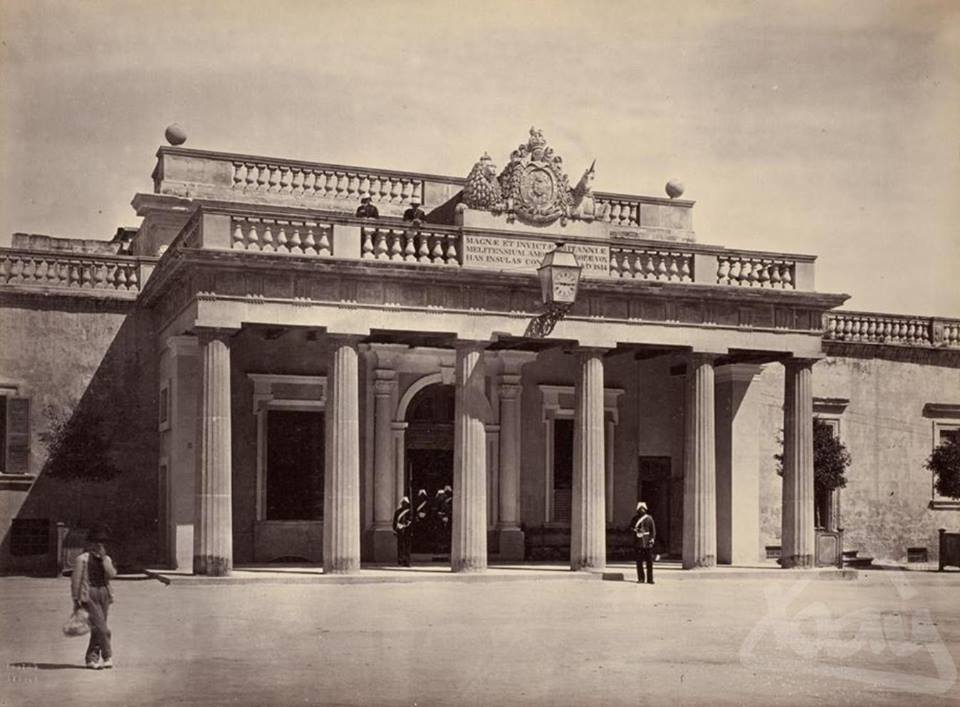
Inscription:
MAGNAE ET INVICTAE BRITANNIAE
MELITENSIUM AMOR ET EUROPAE VOX
HAS INSULAS CONFIRMAT A.D. 1814
Translation:
The love of the Maltese and the voice of Europe
confirm these islands
to the great and unconquered Britain
A.D. 1814
Comment: The building was originally used by the Order of St. John to house the Regimento di Guardia. Similarly, under British rule, it served as a guardhouse to watch over the Palace of the British Governor of Malta. The inscription below the British Royal Coat of Arms was installed in 1814 when the portico was added. This brief text explicitly confirms that Malta—previously a British protectorate—had officially become a British colony (“possession”), with the full consent and affection of the Maltese people. The statement also notes that this new status had the backing of “Europe,” referring to the Allied powers who were reshaping the continent’s political landscape at the Congress of Vienna (1814–1815).
—–
Location: The frieze of the facade of
ST PAUL’s PRO-ANGLICAN CATHEDRAL
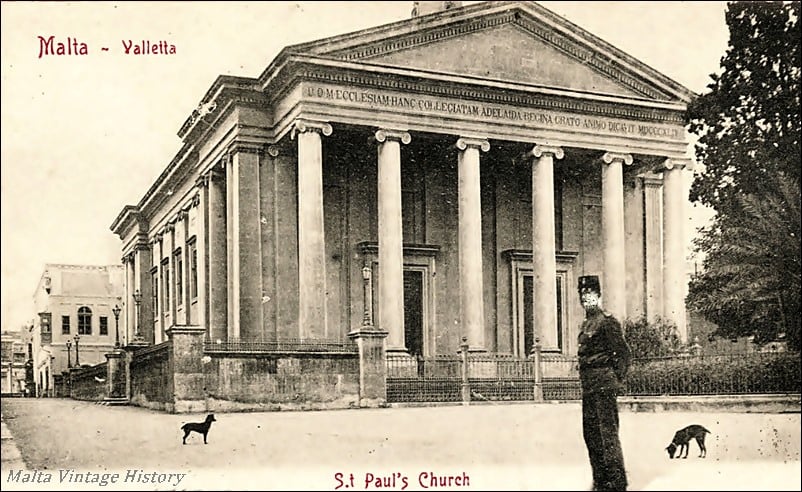
Inscription:
D.O.M. ECCLESIAM HANC COLLEGIATAM ADELAIDA REGINA GRATO ANIMO DICAVIT MDCCCXLIV
Translation:
To God the highest and best – Queen Adelaide gratefully dedicated this collegiate church – 1844.
Comment: St. Paul’s Pro-Cathedral was commissioned by Queen Dowager Adelaide during her stay in Malta in the 19th century. To her dismay, she discovered that British servicemen and personnel on the island had no dedicated Anglican place of worship, save for a small chapel inside the Governor’s Palace. She therefore requested that an Anglican church be constructed, choosing the site where the Auberge d’Allemagne had previously stood. Designed by the architect William Scamp, the Pro-Cathedral was built between 1839 and 1844, with Queen Adelaide herself laying the foundation stone.
——
Location:
Above the entrance of the
Old University of Malta
St Paul Street
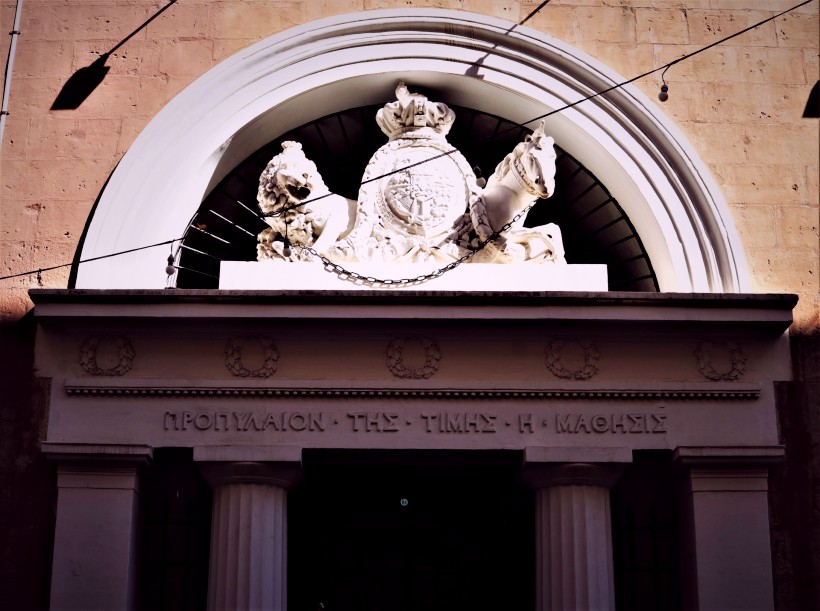
Greek inscription:
PROPULAIONTES TIMES HE MATHESIS
Translation:
Learning is the gateway to honour
Comment: Construction of the building began in 1595 to house a Jesuit college known as the Collegium Melitense. The University of Malta was later formally established on the site in 1769. Today, the Old University Building still houses several academic departments and serves as a venue for lectures, conferences, and ceremonial events.
—–
Location:
The rear of entrance of
VICTORIA GATE
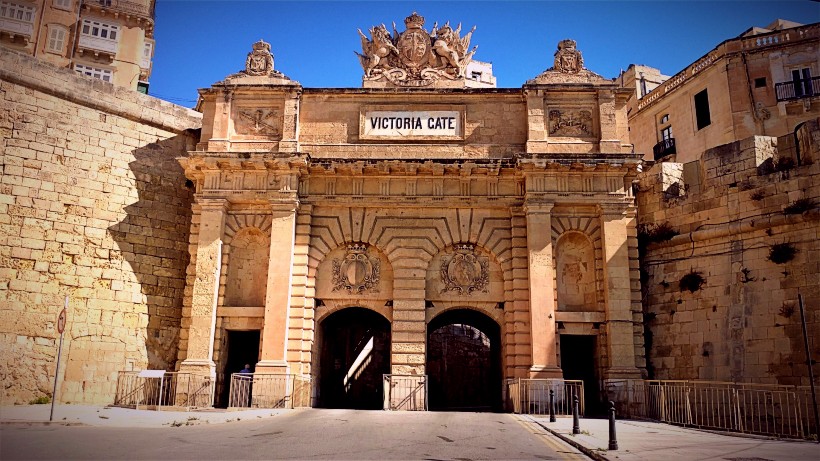
Inscription:
Antiqua huius civitatis porta heic prope patebat quam maiores nostri
LA PORTA DEL MONTE ac deinde PORTA DELLA MARINA
Vocitabant
Cum propter magnam negotiorum copiam nimis acusta evasisset
Demolita fuit et haec nova porta
Ab augustissimae nostrae reignae nomine appellari gaudet
PORTA VICTORIA
Quae amplior et commodior aedificata est
Viaque valde acclivis et flexuosa demissa directaque fuit
Lapis auspicialis salutari precatione lustratus positus fuit
V..kal iunii an. MDCCCLXXXV
Eaque commeantibus adaperta(?) est anno MDCCCLXXXV
Translation:
An ancient gate of this city used to stand open near here, which our ancestors were accustomed to call LA PORTA DEL MONTE and afterwards PORTA DELLA MARINA.
When, on account of a great volume of business, it had become far too narrow, it was demolished, and this new gate rejoices to be called PORTA VICTORIA after the name of our most august queen.
It was built larger and more convenient, and the road, which was extremely steep and winding, was lowered and straightened. The auspicious foundation stone, blessed with a prayer of salvation, was laid.
Comment: The original entrance, known as the Del Monte Gate (or Porta Marina), was built by the Order of St. John in the late 1560s during the reign of Grand Master Pietro del Monte. It served as Valletta’s primary access point from the harbour, heavily used by merchants, sailors, and traders entering the city’s central quarters. In 1884, the British completely demolished the old gate to make way for the present structure—Victoria Gate—which opened in 1885 and was built at a slightly different angle to accommodate increased traffic.
—–
FLORIANA
Location:
The Wignacourt Tower Fountain
(Standing close to Sarria Church)
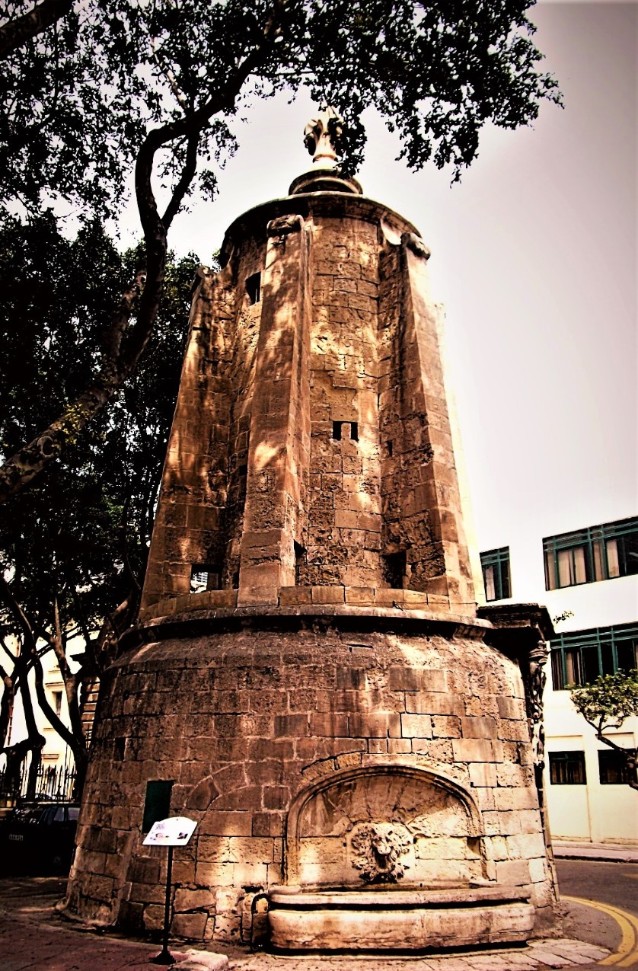
Latin inscription:
TURRICULA ORNATUM LILIIS CAPUT EFFERO UT URBE INSPICIAM FONTEM VIVIFICANTIS AQUÆ.
BONTADINO DE BONTADINIS, BONON. AQUÆ DUCTORE MDCXV
Translation:
From the tower decorated by the lily, I lift my head,
So that I can see the source of water reaching the town
It was Bontadino Bontadini of Bologna
who made that – 1615
Comment: This fountain was one of several supplied by the Wignacourt aqueduct, which channelled water from the springs around Rabat all the way to Valletta. The mention of the fleur-de-lis (lily) is a direct reference to the coat of arms of the Wignacourt family; Grand Master Alof de Wignacourt initiated and personally financed most of the project. Bontadino Bontadini, an Italian engineer, was commissioned to design and lead the construction. The aqueduct remained in active use until 1912.
——
Location:
Facade of Portes des Bombes
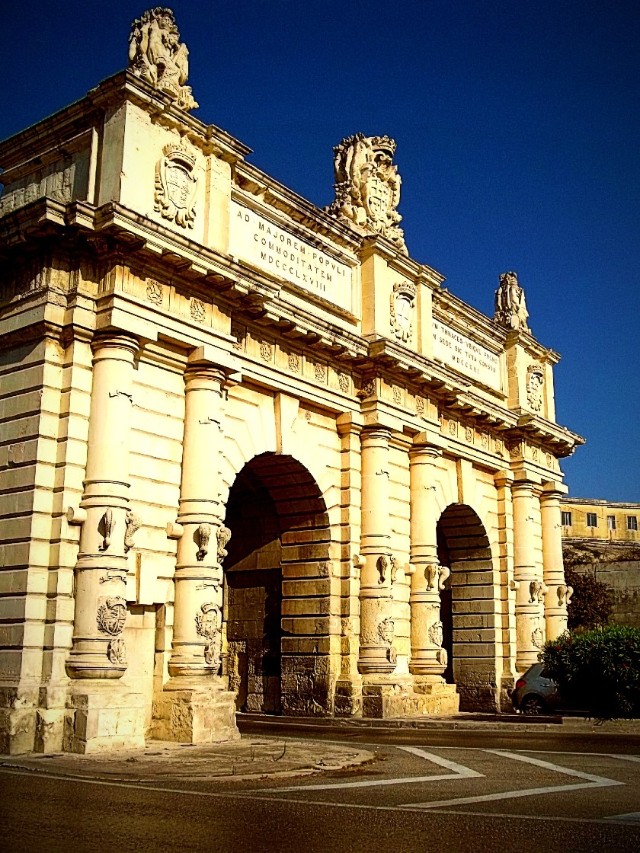
(Older Gate – right side)
DUM. THRACES UBIQUE PUGNO
IN SEDE SIC TUTA CONSTO
MDCCXX1
Translation:
While fighting the Turks in all places
I stay safe in this place
1721.
—–
Second inscription:
PORTES DES BOMBES
(British Period – Gate on the left side)
AD MAJOREM
COMODITATEM
MDCCCLXVIII
Translation:
For the greater convenience of the people
1868
Comment: The two arches commonly known today as Portes des Bombes were constructed at different times. The left arch was the original gate, built by the Order of St. John. The second arch was added by the British to accommodate the growing volume of traffic from the outlying villages. Until the late 19th century, both gates were routinely closed at sunset. Archival photos reveal that traffic passed on the left-hand side—a reflection of the British-mandated traffic system that Malta inherited and still follows today.
——
Location:
BIRGU COUVRE PORTE (inner gate)
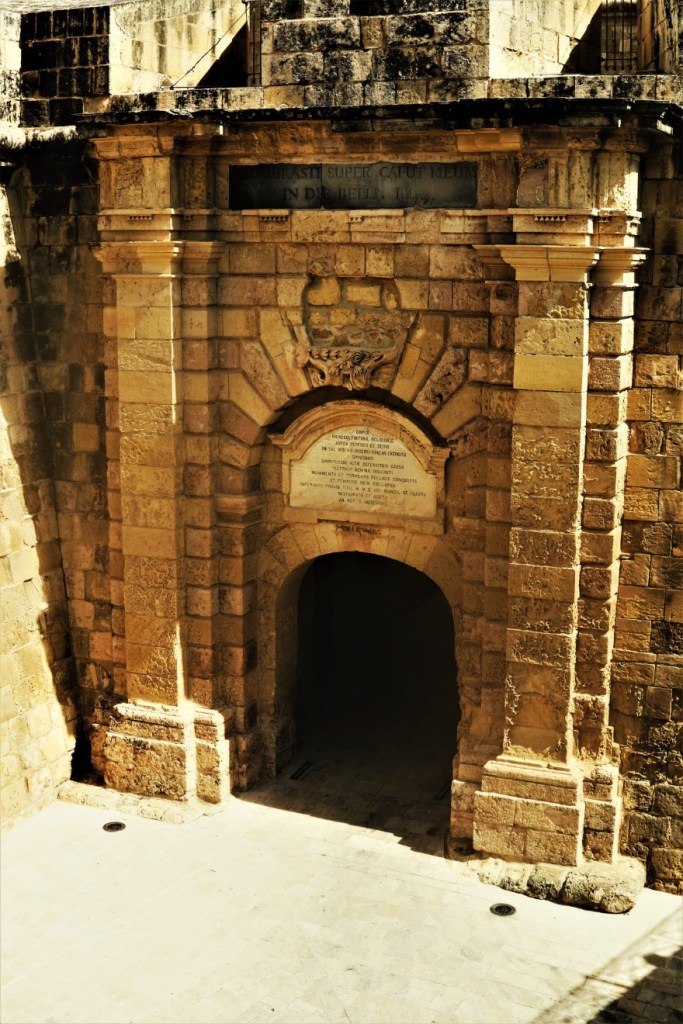
Latin Inscription:
ORPIDI
HIEROSOLMITANI RELIGIONIS
ANTEA PERFUGII ET SEDIS
AN SAL MDLXV. INGENTI TURCAR EXERCITU
OPPUGNATI
DIVINITUSQUE ACTAE DEFENSIONIS CAUSA
VICTRICIS NOMINE INSIGNITI
MUNIMENTA ET TORMETIS BELLICISI CONQUASSA
ET TEMPORE DEIN COLLAPSA
IMPERANTE PROVID. VIGIL. M. M.D. ANT. MANOEL DE VILHENA
ET AUCTA AN. REP. S. MDXXCCVII
Translation:
During the reign of the provident and vigilant GrandmasterAntonio Manoel de Vilhena
The fortifications of the town that was the former seat and refuge of the Gerosolmitan Religion were restored and enlarged in the year of salvation 1727. This town had been attacked by a huge army of the Turks in 1565 but was strongly defended with God’s help and honoured with the name of the victorious town.
Location:
Same Gate – higher level
Latin inscription:
OBUMBRASTI SUPER CAPUT MEUM
IN DIE BELLI
Translation:
You have shielded my head in the day of battle (taken from psalm 139. verse 8.)
Comment: Originally, access into the fortified city of Birgu was made almost entirely through a series of three sequential gates. The outermost entrance, the Couvre Porte proper, sits on the outer perimeter of the fortifications (1722). The second gate, dated 1723, is reached after crossing the moat via a stone bridge. Finally, the innermost gate—built at an angle to the previous two to enhance defense—was erected in 1727.
—–
SENGLEA
Location:
On the inland side of the
Sentinel box
At GARDIOLA GARDEN
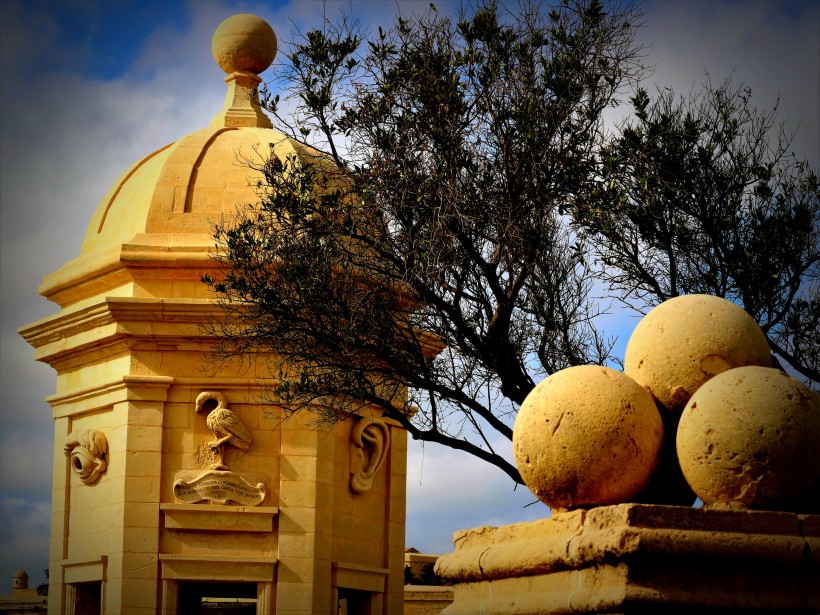
Latin inscription:
PORTIBUS HIC TRIBUS, UNA ET PLURIBUS ARCIBUS ADSTANS. DUM INVIGILO EXCUBIIS, OMNIA TUTA MANENT. MDCXCII.”
Translation:
I am standing here with three harbours and a great deal of fortifications. As I watch over with the guards, all remains safe. 1692.
Comment: This sentinel box—known in Maltese as the gardjola and in English as a vedette—is one of several guarding the Grand Harbour and Marsamxett area. Positioned at strategic vantage points, these structures provided shelter for guards monitoring harbor activity. Carved into the exterior are symbols of vigilance: an eye on one side and an ear on the other. Above the inland doorway rests the image of a crane, an ancient symbol of alertness. According to classical lore, while a flock of cranes slept, a designated sentinel stood guard holding a stone in its claw; if the bird began to doze, the falling stone would startle it awake to resume its watch.
_____
MDINA
Location:
Facade of Main Gate of Mdina
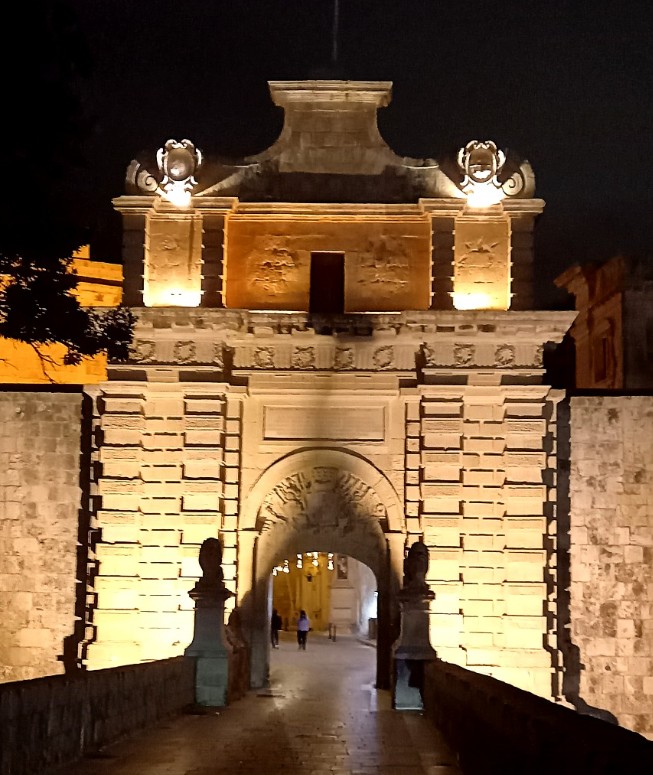
Inscription:
ANTIQUISSIMÆ HUJUS URBIS, QUAM PATRES DIXERE NOTABILEM,
INSULÆ METROPOLEOS,
QUÆ DIVI PAULI PROVIDO NAUFRAGIO FIDEM EDOCTA
PRIMUM PRÆSULEM DIVUM PUBLIUM PATRITIUM HABUIT,
D: ANT: MANOEL DE VILHENA M: M:, EGREGIUS, ET PIISSIMUS PRINCEPS;
IN HONOREM APOSTOLI EJUSQ.’ DISCIPULI, AMOREM, ET TUTELAM POPULI;
MUNIMENTA PENÉ COLLAPSA RESTAURAVIT, ET AUXIT.
ANNO SAL: MDCCXXIV. PRINCIPATUS SUI III.
Translation:
For this most ancient city—deemed notable by the ancients—the metropolis of the island, which, having been instructed in the faith through the providential shipwreck of Saint Paul, had Saint Publius the Patrician as its first prelate,Don António Manoel de Vilhena, Grand Master—an illustrious and most pious prince—restored and expanded the fortifications, which had nearly collapsed,in honor of the Apostle and his disciple, and for the love and protection of the people.In the year of salvation 1724, the third year of his reign.
Comment: Mdina’s main entrance was restored as part of a major project that reshaped much of the citadel’s urban landscape. This renovation replaced older structures with Baroque architecture and reinforced the fortification walls to better withstand artillery fire. Set into the entrance’s facade is the marble escutcheon of Grand Master António Manoel de Vilhena, who initiated and funded the project.
—–
Location:
Facade of Greek’s (Lower) Gate
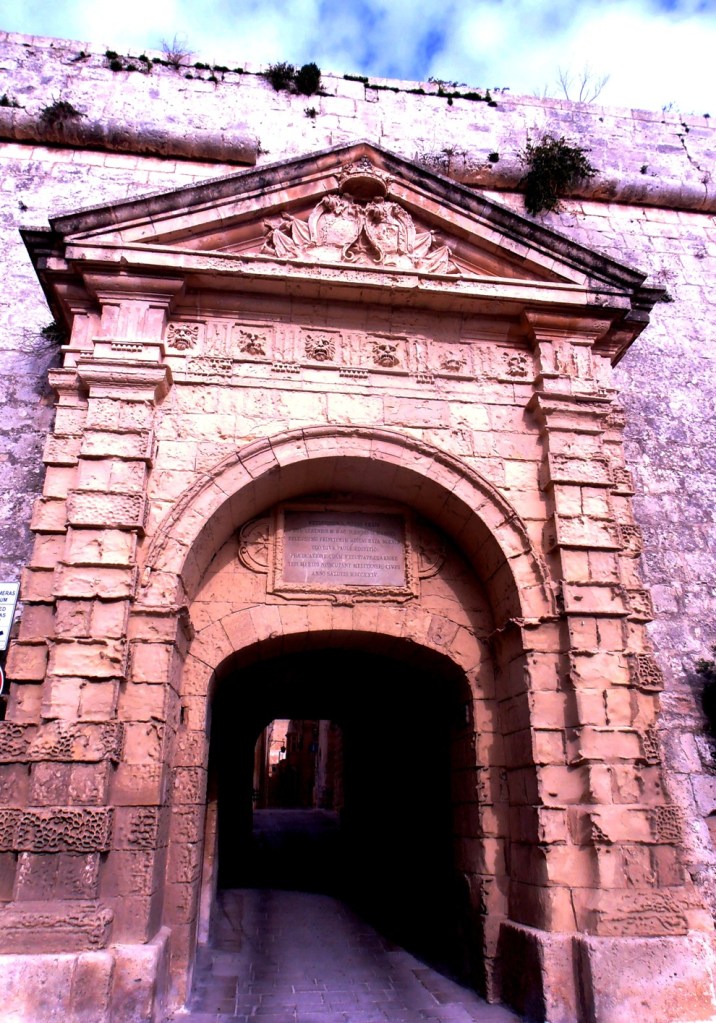
Latin Inscription:
VETUSTISSIMAE HUJUS URBIS
SERENIS. M. MAG. ANTONII D. MANOEL
FEICISSIMO PRINCITATU RETAURATA MOENIA
TUO, DIVE PAULE, HOSPITIO.
PRAEDICATIONE, QUAM VETUSTATE, CLARIORE
TIBI MERITO NUNCUPANT MELITENSES CIVES
ANNO SALUTIS MDCCXXIV
Translation:
The walls of this most ancient city,
restored during the most fortunate reign
of the Most Serene Grand Master Antonio de Manoel,
are dedicated to you, Saint Paul—
whose renown rests more upon your preaching
than upon the city’s antiquity
by the citizens of Malta,
in the year of salvation 1724.
Comment: It is uncertain why this gate—which serves as Mdina’s secondary entrance—came to be known as the Greeks’ Gate. Various theories exist. In Maltese, it is locally referred to as Bieb il-Għarreqin, using an old term that shares linguistic roots with the Arabic word for “Greeks”.
—–
MOSTA
Location:
Basilica dedicated to the Assumption
(frieze over portico)
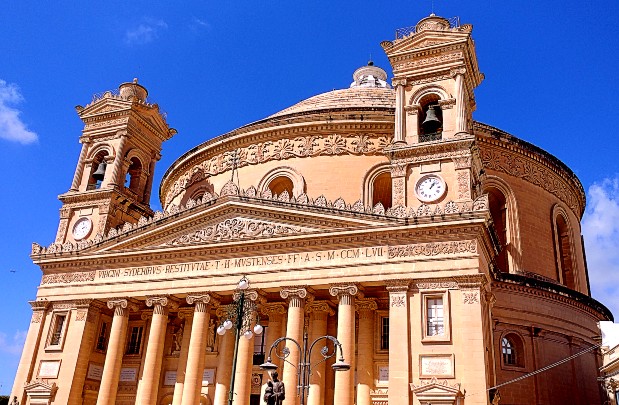
Latin Inscription:
Virgini Syberibus Restitituitae T.H. Mystenses F.F. A.S. M.CCM.LVII
Translation:
To the Virgin who went to Heaven, this temple was erected by the people of Mosta in 1857
—–
Location:
Interior of bazilica: Frieze above the architrave
Latin Inscription:
Maria Virgo Assumpta est ad Aethereum Thalamum in Quo Rex Regum Stellato Sedet Solio.
Translation:
Mary in the glory of heaven where the King of Kings sits on his throne.
Comment: The Mosta Dome was the first church in Malta constructed in the Neoclassical style. Built between 1833 and 1860, its design emulates—but does not strictly copy—the Pantheon in Rome.
—–
Location:
Numerous chapels and churches all over Malta and Gozo.
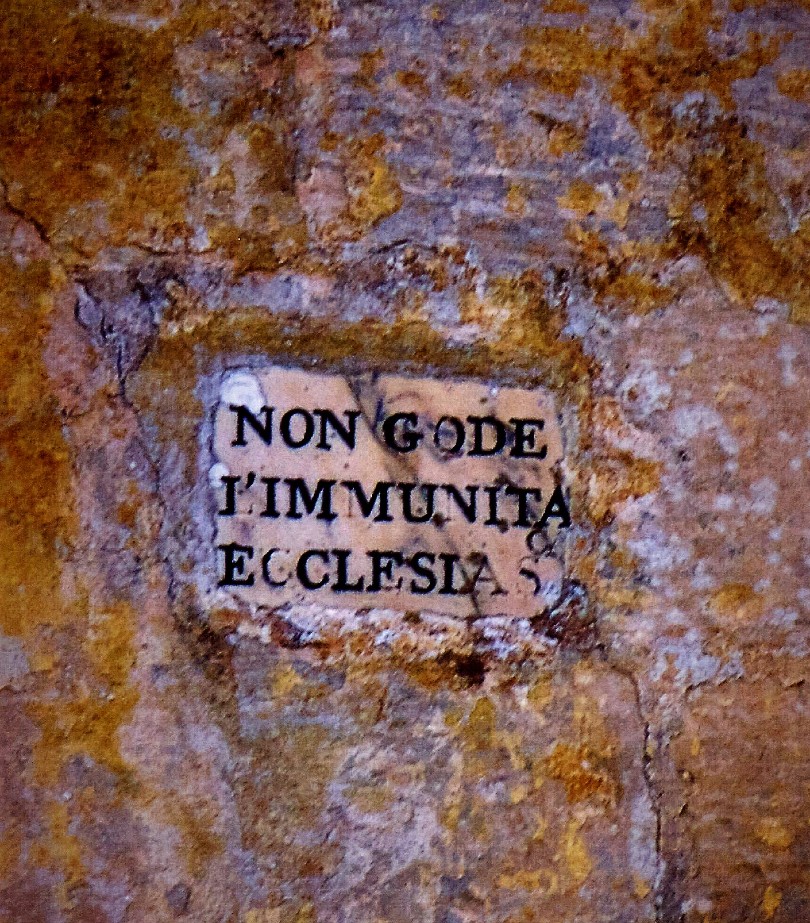
Inscription in Italian:
NON GODE L’IMMUNITÀ ECCLESIASTICA
Translation:
(This place) does not enjoy ecclesiastical immunity
Comment: Malta is dotted with numerous small chapels, many of which feature a small marble inscription near the main entrance stating that the church does not offer sanctuary to those fleeing state jurisdiction. In earlier times, secular officers of the Order of St. John were strictly forbidden from entering Church property for any reason. This privilege of sanctuary was partially abolished in 1761, following an agreement between the Order and the Church. The inscription Non Gode l’Immunità Ecclesiastica served as a clear warning to all potential fugitives. This arrangement remained in place until 1828, when a subsequent agreement between the Church and the British Governor abolished the privilege of sanctuary entirely.
Martin Morana©
August 27, 2026
Bibliography
Cassar Paul, The Castellania Palace. Department of Information. 1988.
Denaro Victor F., The Houses of Valletta. Malta. 1967.
Guillaumier Alfred, Bliet u Rħula Maltin. Malta. 1972.
Scicluna P. Hannibal, The Order of St. John of Jerusalem and Places of Interest in Malta and Gozo. Empire Press. 1969.
Vella E.B., Storja tal-Mosta bil-Knisja Tagħha. Empire Press. 1930.

